

Infidelity in Couples: What It's Really About
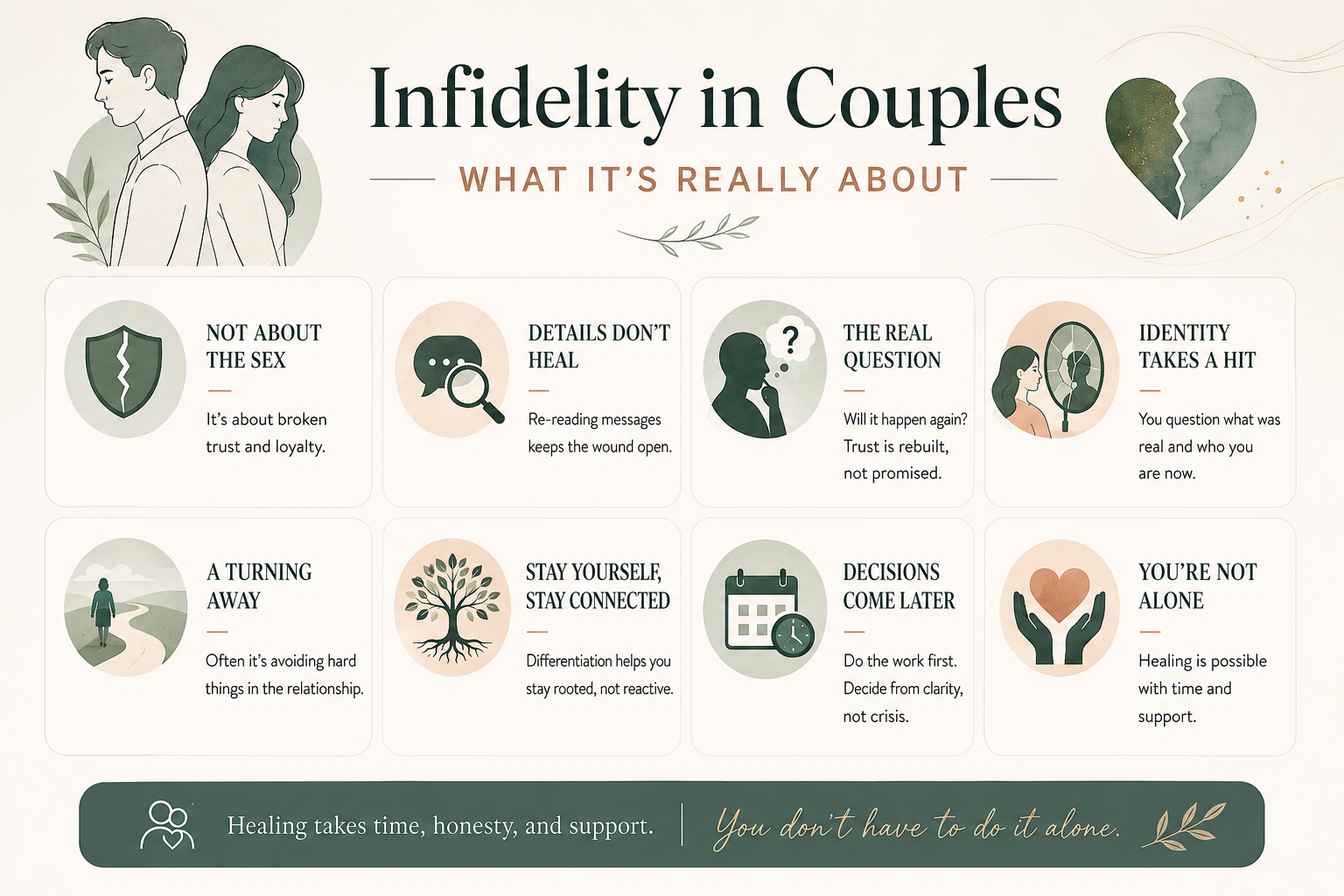
Most of what we hear about infidelity is surface-level — who, when, how many times. It's an understandable place to start, but it's also where most people's understanding stops. In the therapy room, infidelity is rarely, at its core, about sex. It's a betrayal of trust and loyalty. And what happens after discovery is often more complicated, and more workable, than people expect.
It's not really about the sex
When a couple comes in after infidelity, the first questions are almost always about the physical details. Understandably — there's an urge to know everything. But the deeper injury usually isn't the sexual act itself. It's what the affair represents: a partner chose, repeatedly, to keep a part of themselves hidden. That's what breaks something. Not the specific acts, but the loyalty and trust that were supposed to hold the relationship together.
Why the details make it worse, not better
One of the hardest parts of this process is what happens once the communication trail comes to light — texts, messages, the small ordinary things that were said to someone else. Reading through that trail doesn't just confirm what happened. It adds a whole new layer of trauma. It's common for the betrayed partner to fall into obsessive rumination, replaying the same messages, searching for a detail that will finally make sense of it. That obsession isn't a character flaw or an overreaction. It's what a wound like this does to a person's nervous system — it keeps looking for the piece of information that will make it feel safe again, and that piece rarely exists.
The question underneath the question
Eventually, most people who've experienced infidelity arrive at the real question, the one underneath all the others: will this happen again? How can I possibly be sure?
There's no evidence that fully answers that question, which is part of what makes this so hard to sit with. Certainty isn't something a partner can hand back to you, no matter how much reassurance they offer. What actually rebuilds trust is slower and less satisfying than a guarantee — it's consistency, transparency, and time. But it's real, and it's something couples can work toward together.
When the ground shifts under you
Infidelity often triggers something bigger than hurt over the affair itself — it can shake a person's sense of identity. Who am I in this relationship now? Was any of it real? What was actually true, and what wasn't? These aren't dramatic questions — they're the natural result of finding out that a story you believed about your life wasn't the whole story. Making sense of what's real and what isn't takes time, and it's a normal part of this process, not a sign that something is wrong with you for struggling with it.
What infidelity often is a turning away from
Here's something that reframes this for a lot of couples: infidelity is frequently a choice to turn away — not necessarily toward the other person, but away from something hard happening in the relationship itself. Away from a difficult conversation. Away from a stretch of emotional growth that would have required sitting in discomfort, being vulnerable, or facing something uncomfortable about themselves.
When someone turns away like this, they don't have to sit through the hard conversation. They don't have to sit behind the things they don't want to feel or face. It can feel, in the moment, like relief. It's rarely framed that way afterward, but that's often what's underneath it.
People who've had affairs frequently describe the "spark" as something that came from the other person — a feeling they didn't think they could access anymore. But that spark was never actually coming from the other person. It was something inside them, waiting to be found — and it's worth asking what it would take to find that feeling from the inside, rather than needing someone else to generate it.
Differentiation: staying yourself while staying connected
A concept that comes up a lot in this work is differentiation — the ability to know what you feel, what you think, and what you desire, and to hold onto that clearly even when it's different from your partner's experience.
Differentiation isn't about agreeing. It's about being able to say: I know what's true for me. I can also hold that what's true for you might be different — and I don't have to escalate, shut down, or lose myself in order to stay connected to you anyway. Can I be present with someone who isn't the same as me, without needing them to match me in order to feel safe?
This is different from individuation, which is more about the things you do on your own — hobbies, interests, pursuits that are yours alone and that build your individual sense of self-worth. Differentiation is specifically about how you relate: staying rooted in yourself while staying in relationship with someone whose inner world doesn't mirror yours.
Couples who are working to rebuild after infidelity often find that this is the real, underlying skill they're building — not just repairing the specific betrayal, but developing the capacity to stay differentiated with each other going forward.
The decision comes later, not first
One thing I try to help couples understand early on: the decision about whether to stay together isn't something you make at the beginning of this process. It comes at the end — once you've done enough of the work to actually be equipped to attempt repair, and to make that decision from a clear place rather than from panic, guilt, or fear.
Trying to decide "are we staying together" in the first few weeks after discovery usually means deciding from the most reactive, least informed version of yourselves. Slowing down isn't avoidance. It's what makes an eventual decision — whatever it is — one you can actually trust.
If you're in the middle of this right now
If any of this resonates — the obsessive replaying, the identity questions, the feeling that you no longer know what was real — you're not doing this wrong. This is what infidelity does, and it's exactly the kind of thing couples therapy is built to help you work through, at a pace that lets you actually get somewhere.