

Scarcity Mindset in High Achievers: Why Success Still Doesn't Feel Safe
I work with a lot of people who, on paper, have made it. Good title, good comp, good trajectory. And in session, they're still bracing — like the ground could shift under them at any moment.
That's a scarcity mindset. And it's one of the most common things I see sitting underneath high achievers' stress, even when everything on the outside looks stable.
What is a scarcity mindset
A scarcity mindset is the belief, often below conscious awareness, that there isn't and won't be enough. Not enough money, not enough opportunity, not enough security, not enough time to get it all done before something goes wrong. It's different from realistic caution. Caution says let me plan for this. Scarcity says nothing I have is actually safe, no matter how much I accumulate.
The tricky part is that a scarcity mindset doesn't go away once the scarcity does. You can have every marker of success and still feel like you're one misstep from losing it all. That gap — between what's actually true and what you feel is true — is the whole problem.
Where it comes from
Scarcity mindset usually isn't random. It tends to be rooted in something real: growing up without financial stability, watching a parent lose a job or a business, immigrating and having to rebuild from nothing, or simply being raised in a household where money, achievement, or security was talked about as fragile and hard-won. For a lot of my South Asian and immigrant clients, this also carries a generational layer — the idea that stability was fought for by someone before you, and losing it wouldn't just be your loss, it would be a failure to honor that.
Once that belief takes hold, it doesn't need ongoing evidence to keep running. It just needs a nervous system that learned, early, that resources are precarious and vigilance is what keeps you safe.
How it shows up in high achievers
This is the part that surprises people: scarcity mindset doesn't just show up as fear of failure. In high achievers, it often shows up as fear of loss of success — a distinct, quieter kind of dread that follows you even when things are going well.
In the therapy room, it sounds like:
"I know I'm doing well, but I can't relax into it."
"If I stop pushing, I'm scared everything falls apart."
"I got the promotion and felt relief for about a day, then started worrying about the next one."
"I don't feel like I've 'made it' — I feel like I'm one bad quarter away from losing everything."
High achievers are often praised precisely because scarcity mindset makes them productive — vigilant, driven, always optimizing. But underneath the output, there's rarely a sense of enough. The finish line keeps moving, because the mindset was never really about the goal. It was about the fear.
Why Silicon Valley makes this worse
Silicon Valley is, structurally, one of the most scarcity-triggering environments a high achiever can be in — even though it's full of people who are, by most standards, doing extremely well.
Compensation is often tied to equity that can evaporate. Roles get eliminated in waves that have nothing to do with individual performance. Company loyalty rarely runs in both directions the way it once did. And the culture rewards constant reinvention — you're expected to already be building toward the next title, the next skill set, the next company, before you've had a chance to feel settled in the current one. Add a tight, visible peer group where everyone can see everyone else's trajectory, and you get comparison that runs around the clock.
None of this creates scarcity mindset out of nothing. But if the belief is already there, Silicon Valley is exceptionally good at confirming it. The environment says, over and over: nothing here is guaranteed, no matter how well you're doing.
How AI is turning up the volume
Right now, AI is adding a new, very immediate layer to this. A lot of what I'm hearing in session isn't really about AI itself — it's scarcity mindset finding a new, urgent-feeling reason to be right.
"What if I become obsolete?""Everyone's racing to learn this and I'm already behind.""Even if I'm good at my job today, will that be true in a year?" These aren't just questions about a tool. They're the scarcity belief — there won't be enough room for me — attaching itself to the most uncertain thing currently happening in tech. AI didn't create the underlying fear. It gave it a very current, very plausible story to run on.
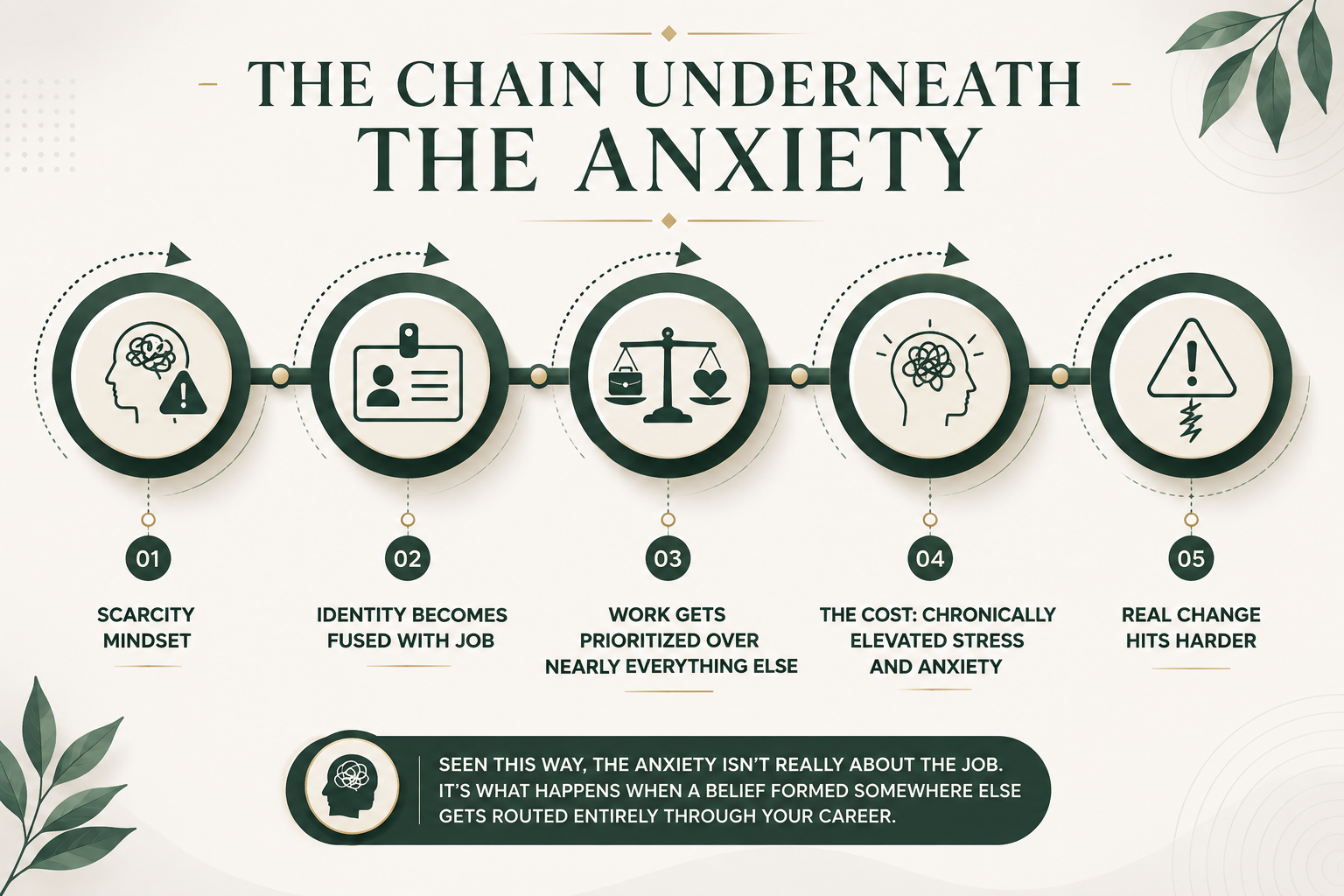
The chain underneath the anxiety
When I trace this pattern with clients, it tends to follow a fairly consistent path:
Scarcity mindset creates a fear of losing the resources attached to your job — income, status, stability. Because so much of that is tied to the job specifically, your job identity becomes fused with your self-worth: I am what I produce, what I'm paid, what I'm called. Once identity and worth are riding on the job, work naturally gets prioritized over nearly everything else — rest, relationships, health, anything that doesn't visibly protect the thing you're afraid of losing. That prioritization comes at a cost: chronically elevated stress and anxiety, because you're operating as if the threat is constant. And by the time real change hits — a layoff, a reorg, an AI-driven shift in your role — you're already stretched thin, which makes it much harder to cope with the change when it actually arrives.
Seen this way, the anxiety isn't really about the job. It's what happens when a belief formed somewhere else gets routed entirely through your career.
What actually helps
This isn't a pattern you talk yourself out of by listing your accomplishments — most high achievers have already tried that, and it doesn't hold. What tends to help is going further back: understanding where the belief that there's not enoughactually came from, and starting to separate your sense of safety from your output.
That's slower work than a productivity fix, but it's also the only kind that lasts. If any part of this — the bracing, the inability to relax into success, the sense that you're one step from losing it all — sounds familiar, that's worth paying attention to, not pushing past.
You don't have to have it figured out to start
A lot of people wait to reach out for help until things feel "bad enough." The threshold isn't crisis. The threshold is: I'm carrying something and I'd like some help.
If anything you read here resonated — that's probably enough.