

How to Regain Motivation During Depression: Practical Tips That Can Help
"I know what I should be doing. I just can't make myself do it."
I hear some version of this almost every week. And it usually comes with a layer of shame stacked on top — like the lack of motivation is a character flaw instead of a symptom. If you've been searching for how to get motivated when depressed, you've probably already tried willing yourself into it, and you've probably already noticed that doesn't really work.
Low motivation and depression go hand in hand. It's not laziness, and it's not a sign that you don't care about your life. Depression is a real shift in your brain's chemistry and energy systems — it makes even small tasks feel like they require more than you have to give. Low motivation is one of its most common — and most misunderstood — symptoms. Here's what actually helps.
Start by acknowledging where you're at
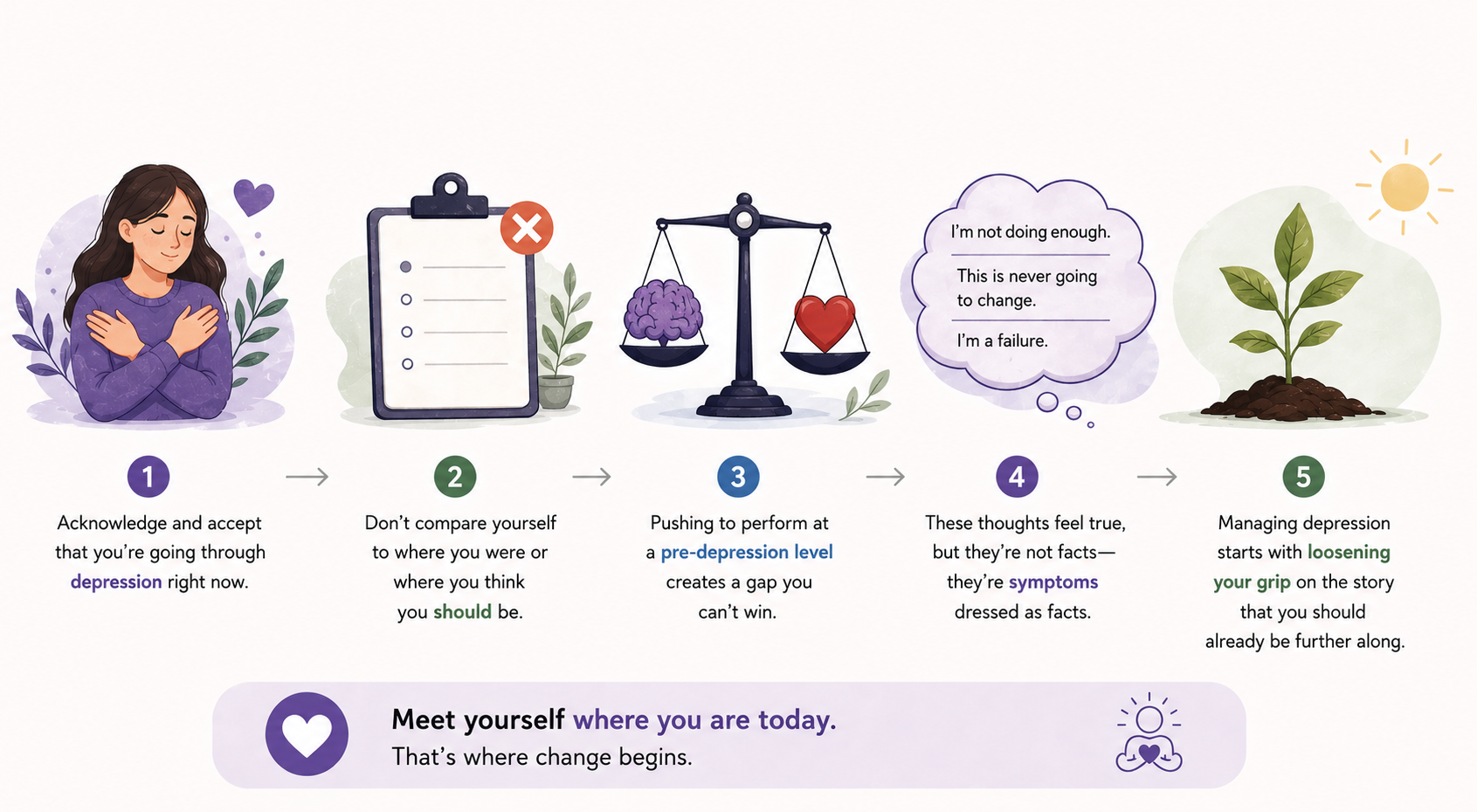
Before any strategy, there's a step that gets skipped a lot: acknowledging and accepting that you're going through depression right now.
That sounds simple, but it's not the same as giving up or "just accepting things as they are forever." It means meeting yourself where you actually are today, instead of where you were six months ago or where you think you should be. When you push yourself to operate at a pre-depression level of output, you're setting up a comparison you can't win — and that gap tends to feed the very beliefs that keep depression going: I'm not doing enough. This is never going to change. I'm a failure.
Those thoughts feel true. They're also not facts — they're symptoms, showing up dressed as facts. Managing depression starts with loosening your grip on the story that you should already be further along.
Make a list of what's actually accessible right now
Once you've let go of the pre-depression bar, the next question is: what's realistic for you today?
This is different for everyone, and it changes week to week. For some people it's making the bed. For others it's getting dressed for work, or eating two meals instead of zero. Write down a short list of things that feel accessible — not impressive, not ambitious, just doable — while being honest with yourself that even those things won't feel as easy as they used to.
This isn't about lowering your standards forever. It's a way to keep showing up to your life in small, consistent ways while your capacity is lower than usual. Staying motivated with depression rarely looks like a big turnaround — it looks like a short list you can actually finish.
Move before you feel like it
One of the most well-supported tools for motivation during depression is something called behavioral activation, and it works in the opposite order from how we usually assume motivation works.
We tend to think: I'll do the thing once I feel motivated. Behavioral activation flips that. You do the thing first — go for a short walk, step outside, get moving — even though you don't feel like it and even though nothing in you wants to. Your brain doesn't register the feeling of an activity as evidence that it helps. It registers the doing of it. Over time, showing up to small activities, even joyless ones, teaches your brain that this action is connected to feeling a little better afterward. That connection is what eventually brings the motivation back.
So if you're waiting to feel like doing something before you do it, that's likely to be a long wait. Step outside anyway. The motivation tends to follow the action, not the other way around.
Notice the thoughts and hold them a little more loosely
Depression doesn't just lower your energy. It also turns up the volume on a specific kind of thinking — harsh, hopeless, self-critical. I'm behind. I'm not trying hard enough. Nothing is going to change.
Part of learning how to stay motivated with depression is learning to notice those thoughts without immediately treating them as true. Remind yourself: this thought is loud right now because of what you're going through, not necessarily because it's accurate. It may or may not be true — and right now isn't always the moment to figure that out.
A useful practice here is simply writing the thought down. Get it out of your head and onto paper, and give yourself permission to leave it there for now. You're not ignoring it or pretending it doesn't exist. You're just deciding you don't have to resolve it in this exact moment, while you're least equipped to look at it clearly.
This isn't something you have to figure out alone
Depression makes everything feel heavier and slower, including the parts of you that used to move without thinking twice. If you're in it right now, the goal isn't to snap back to full speed. It's to find the smallest next step you can actually take, and to stop treating your struggle as proof that something is wrong with you.
If nothing here feels like it's been enough on its own, that's common, and it's not a sign you're doing this wrong. Sometimes motivation during depression takes more support than tips and strategies can offer — and that's exactly what therapy is for.
You don't have to have it figured out to start
A lot of people wait to reach out for help until things feel "bad enough." The threshold isn't crisis. The threshold is: I'm carrying something and I'd like some help.
If anything you read here resonated — that's probably enough.