
What Stress Actually Looks Like (And What Helps When You're In It)
You know the feeling before you can name it. Your chest gets tight during a meeting that should feel routine. You snap at your partner over something small. You reread the same email four times and still can't respond. Or maybe it's quieter than that — you just feel foggy, flat, and far away from yourself.
This is stress. And it rarely looks like what we picture when we hear the word.
What Does Stress Actually Look Like?
We tend to imagine stress as visible panic — racing heart, shaking hands, an obvious meltdown. Sometimes it is that. But stress is often much subtler, and much more disguised. It can look like:
Irritability that seems to come out of nowhere
Procrastinating on the exact thing you need to do
Trouble sleeping, or sleeping but not feeling rested
Difficulty concentrating or making even small decisions
Physical symptoms — a tight jaw, shallow breathing, stomach issues, headaches
Numbness or a sense of going through the motions
Overworking, overplanning, or over-apologizing
Stress is your nervous system's response to a perceived threat or demand that exceeds what you feel equipped to handle in that moment. It doesn't need to be a crisis to trigger this response — a full inbox, an unresolved conflict, or an important decision can activate it just as effectively as something more obviously dangerous.
It Looks Different in Everyone
There's no single "correct" way to be stressed, and this matters more than it might seem. If your version of stress doesn't match what you've been told stress is supposed to look like, it's easy to miss it in yourself — or to minimize it because "it's not that bad."
Someone raised to be the responsible one might experience stress as overfunctioning: taking on more, apologizing less, and pushing through until they physically can't. Someone else might go quiet and withdraw. A high-achieving professional might channel stress into perfectionism, redoing work that was already fine. None of these are wrong. They're shaped by temperament, culture, family patterns, and what felt safe to express growing up. Recognizing your own particular signature of stress — the specific way it shows up for you — is often the first real step toward managing it.
The Four F's: Fight, Flight, Freeze, Fawn
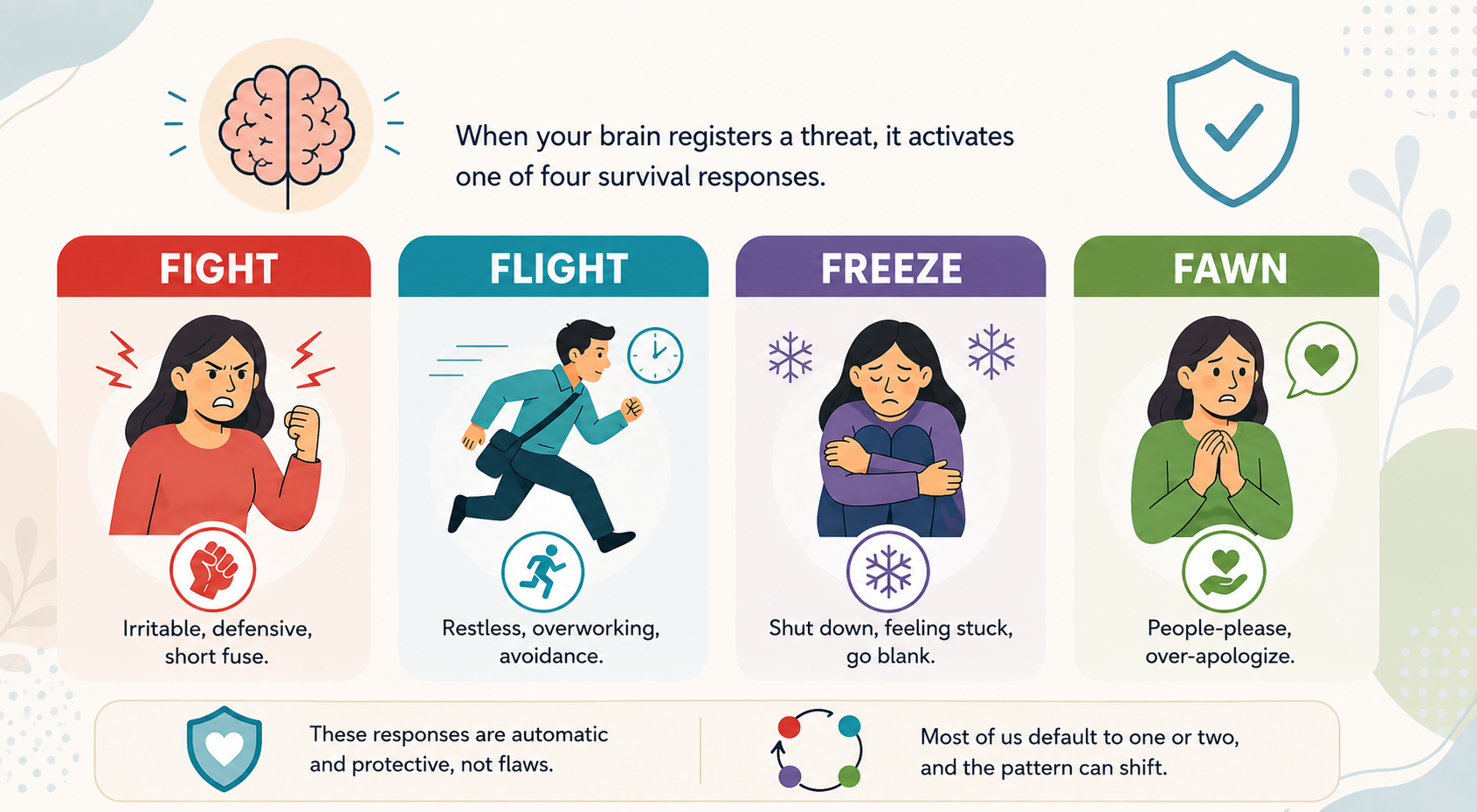
Underneath these different presentations is the same nervous system doing its job. When your brain registers a threat, real or perceived, it activates one of four survival responses:
Fight — irritability, defensiveness, a short fuse, an urge to control or push back.
Flight — restlessness, overworking, avoidance, a drive to stay busy so you don't have to feel what's underneath.
Freeze — shutting down, feeling stuck, going blank, struggling to start or finish tasks.
Fawn — people-pleasing, over-apologizing, difficulty setting boundaries, prioritizing everyone else's comfort over your own needs.
Most of us default to one or two of these, and it's common for the pattern to shift depending on the relationship or situation. None of these responses is a character flaw — they're automatic, protective, and often learned early. But left unexamined, they can start running your life without your consent.
How Stress Quietly Reshapes Your Relationships, Work, and Self-Care
Stress rarely stays contained to the thing that caused it. When your nervous system is activated, it changes how you show up everywhere else, too.
In relationships, stress can show up as shorter patience, less capacity for repair after conflict, or pulling away from the people you'd normally lean on. For fawn-response folks especially, stress can mean saying yes to things you don't have room for, which quietly builds resentment.
At work, stress can narrow your thinking, making it harder to be creative, collaborative, or flexible. You might notice yourself micromanaging, procrastinating, or losing confidence in decisions you'd normally make easily.
With self-care, stress is often the first thing to get cut. Movement, meals, sleep, and rest start to feel like luxuries instead of necessities — even though they're exactly what your body needs more of when it's under load.
Why Decision-Making Gets Harder Under Stress
When your nervous system perceives threat, your body prioritizes survival over reflection. Blood flow and energy shift toward the more reactive, instinct-driven parts of the brain and away from the prefrontal cortex — the part responsible for planning, weighing options, and thinking through consequences. This is useful if you need to move fast. It's much less useful for the kind of decisions most of us are actually facing: whether to take the job, how to respond to a hard email, what to say in a difficult conversation.
This is why decisions made under acute stress often feel urgent and clear in the moment, and then look different once you've had a chance to settle. It isn't a failure of judgment. It's biology. Which is exactly why having a way to downshift your nervous system before making an important decision isn't optional — it's strategic.
Tools That Actually Help
Ground yourself first. Before you try to think your way out of stress, help your body know it's safe enough to think. A simple breathing pattern — inhale for 4 counts, hold for 3, exhale for 4 — can help regulate your nervous system in real time. Pressing your feet firmly into the ground and noticing the contact can pull you out of your head and back into your body. Movement helps too: a short walk, stretching, even shaking out your hands and shoulders can discharge some of the activation your body is holding.
Start with what's easy and familiar. When you're overwhelmed, resist the instinct to tackle the hardest or newest task first. Give yourself something low-stakes and familiar to do — it builds a sense of momentum and capability that makes the harder things feel more approachable.
Break tasks into smaller goals. A single large task can feel like a wall. Smaller pieces feel like steps. Instead of "finish the project," try "outline the first section." Progress, even small, tells your nervous system that things are moving and manageable.
Ask yourself the worst-case question — and then answer it fully. Stress often runs on a vague, looming sense of "something bad will happen." Naming the actual worst-case scenario can be clarifying rather than frightening, especially when you follow it with: if that happened, what resources, people, and skills do I have to handle it? Most of the time, you'll find you have more to work with than the anxious version of the story gives you credit for.
Let Yourself Feel What You're Feeling
It's tempting to treat stress as a problem to eliminate as quickly as possible. But difficult feelings that show up under stress — fear, frustration, sadness, overwhelm — usually aren't the problem. They're information, and they're asking to be acknowledged, not argued with. Trying to push them away or reason your way out of them often takes more energy than simply letting them be present while you keep moving through your day. Acceptance here doesn't mean resignation — it means making room for the feeling instead of spending energy fighting its existence.
Ask What's Really Being Activated
Stress often has two layers: the immediate trigger, and the deeper belief or expectation it's brushing up against. A tight deadline might activate a belief like I have to be perfect or I'll be seen as incompetent. A disagreement with a partner might activate if I have needs, I'll be too much. These beliefs are often internalized early — from family, culture, or messages about who you're supposed to be — and they don't always match what's actually being asked of you in the moment.
The same is true of external expectations. Sometimes the pressure you feel is real and coming from your environment. Sometimes it's a should you've inherited rather than one you've chosen. Pausing to ask, whose expectation is this, and is it actually mine? can take some of the charge out of the stress response and clarify what you're really responding to.
When It's Not Urgent, Let Yourself Be Calm
Not every stressor requires an immediate decision, even though your body may insist otherwise. When you notice that something genuinely can wait, give yourself permission to do something calming instead of something productive — not as avoidance, but as a way of letting your nervous system settle before you engage. A regulated mind makes better decisions than an activated one. Rest, in these moments, isn't the opposite of getting things done. It's often what makes getting things done well possible.
You Don't Have to Figure This Out Alone
Stress is universal, but the way it shows up in you — shaped by your history, your culture, and the expectations you carry — is specific. Learning your own pattern, and building tools that actually fit how your nervous system responds, is work that's much easier to do with support.
At Spiral Up Therapy, we help individuals — especially high-achieving professionals, women navigating career and relationships on their own terms, South Asian clients, and LGBTQ+ individuals — understand their stress responses and build a more sustainable relationship with pressure, expectation, and self-care. Sessions are fully virtual, so you can access support from wherever you are in California or New Jersey.
If you're ready to explore this further, reach out to schedule a consultation.